

Two-year RCT earns Eedi a gold efficacy certificate from EduEvidence
Eedi has earned a gold certificate for Efficacy from EduEvidence.org, the international center for edtech impact.
Powered by Eedi’s diagnostic engine, our testbed platform, Eedi School, works by surfacing targeted questions that map incorrect answers to a student’s specific misconceptions, then feeds that data back to teachers so they can act on it in real time. This trial ran over two academic years (2023-2025) and tested Eedi School as a classroom and homework tool; it did not include Eedi Tutor, Eedi's AI tutor, which is powered by the same diagnostic engine.
We earned the Efficacy certificate by demonstrating statistically significant impact through a randomised controlled trial, independently verified by WhatWorked Education (WWEd), a UK based evaluator we've been working with since 2022. WWEd conducted all analyses.
What we did
The two-year trial showed pupils using Eedi outperformed control pupils by an effect size of 0.30 SD at 24 months (p = 0.004), around four months of additional maths progress (Education Endowment Foundation, see p. 6), and a large effect on Kraft's (2020) benchmarks for education trials, where the typical effect is about 0.10 SD. The comparison was against business as usual, which for most control schools already included another maths platform, so these results represent impact over and above existing digital provision.
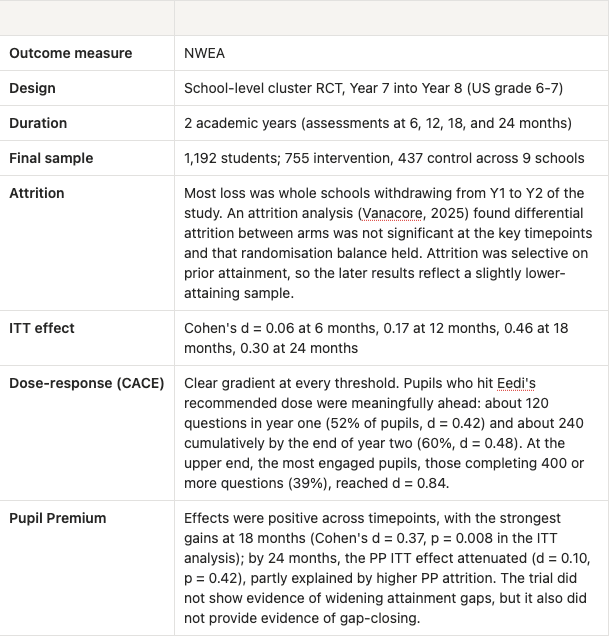
The study at a glance:
The Two-Year Study: Effects that built over time
This study ran for two full academic years which is unusual. Most edtech RCTs measure outcomes after a few months, or at most, one academic year. Thanks to the length of this study, we were able to explore what happens when a platform like Eedi School becomes embedded over a longer time (Y7 -8).
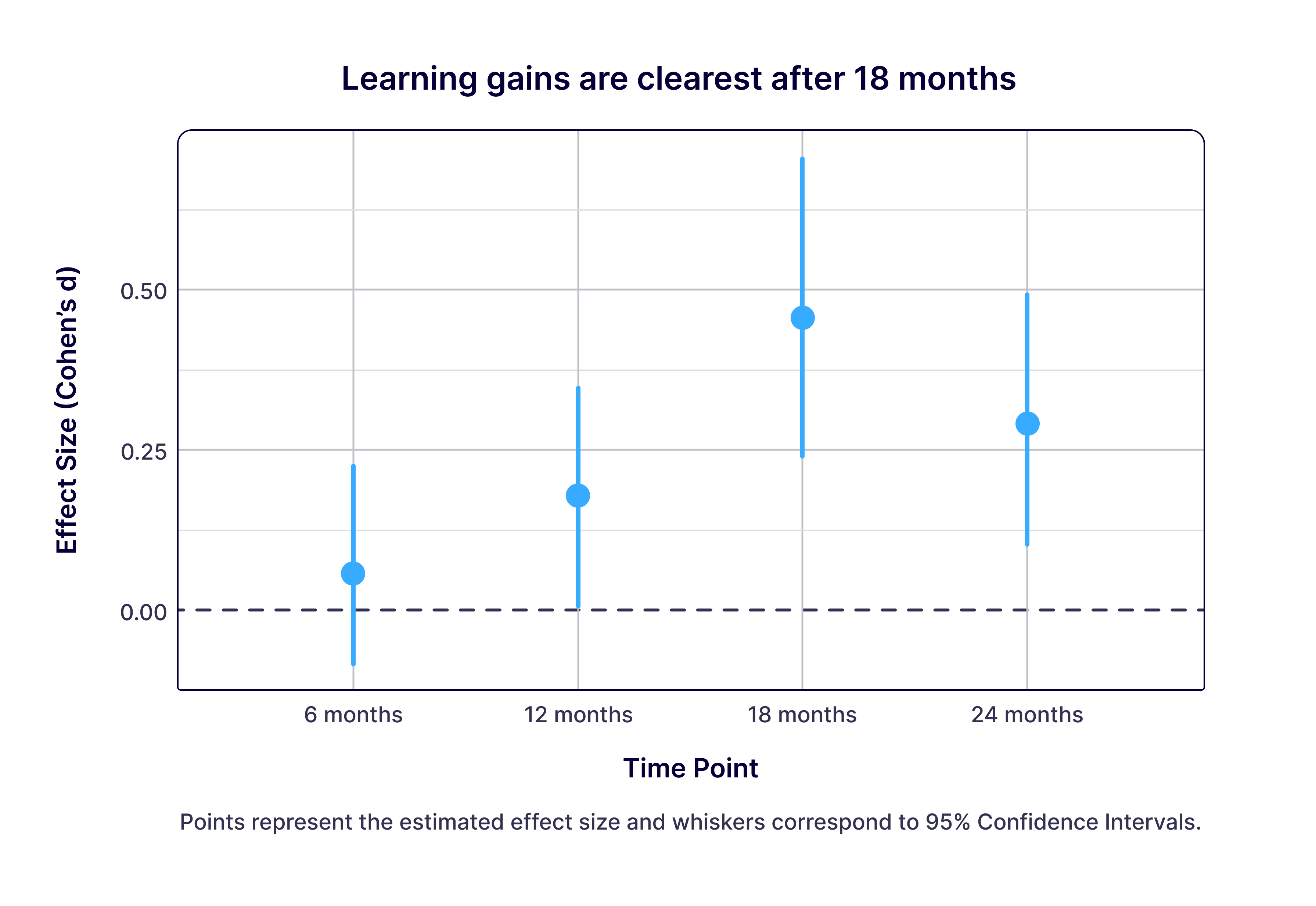
By the end of the second year, pupils using Eedi had outperformed control pupils on a standardised maths assessment by an effect size of Cohen’s d of 0.30 (p = .004), equivalent to approximately four additional months of pupil progress.
By 12 months the effect was on the cusp of significance (d = 0.17, p = .053, 95% CI -0.00 to 0.34); it crossed into clear statistical significance at 18 months (d = 0.46) and held at 24 months (d = 0.30). This suggests cumulative learning gains as teachers and pupils embedded the platform into their routines. Most control schools were already using another maths platform (most commonly MyMaths), so this is Eedi effect size measured over and above existing digital provision, not in comparison to no technology usage.
A few methodological notes: The trial started with about 3,450 pupils across 20 schools at baseline, and finished with a final sample of 9 schools. Running a two-year trial is a big ask: NWEA assessments required a full lesson period multiple times during the year, and schools had not originally planned for consecutive years of participation. An attrition analysis by Dr. Kirk Vanacore (2025) found the treatment-control comparison remained internally valid: baseline balance held and differential attrition between arms was not significant at the key timepoints. Attrition was selective on prior attainment, so the later results are best read as estimates for a slightly lower-attaining population. Notably, control schools dropped out at higher rates than intervention schools (81% versus 62.5% from the original randomisation), which is the opposite of what we'd see if our testbed platform, Eedi School, were burdensome to implement.
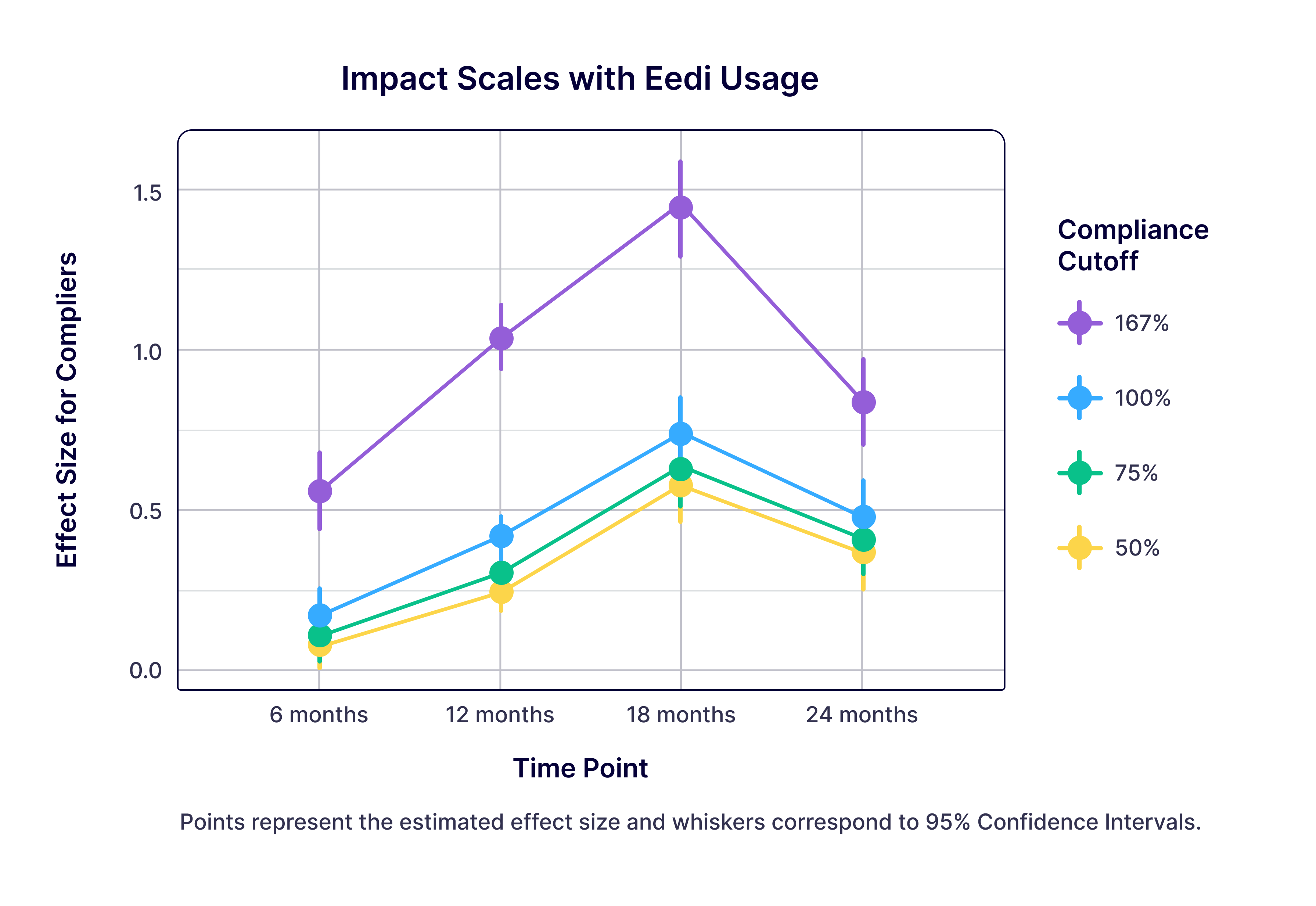
Among the 1,192 pupils who remained in the trial, the exploratory dose-response (CACE) findings were striking. At every time point, higher engagement (completing more diagnostic questions) was associated with larger effects. At 24 months, pupils who completed 240 or more questions (60% of the intervention group) showed a Cohen's d of 0.48, and those who completed 400 or more (39%), a Cohen's d of 0.84. These estimates use randomisation as an instrument, so they are causal for the pupils who comply, not for a typical pupil. What it does show is a consistent pattern: at every threshold, more engagement maps to larger gains, exactly as the platform's theory of change predicts.
We also ran a one-year study. Here’s what its null result taught us
The One-Year Study (class-level cluster RCT)
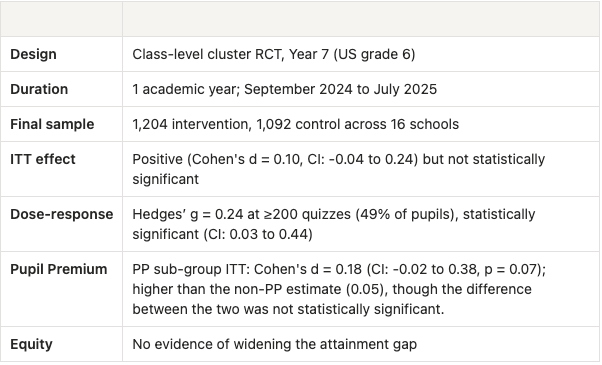
The one-year study told a different story from our two-year, award-winning RCT. The overall intention-to-treat effect was positive but not statistically significant: a Cohen's d of 0.10, with a confidence interval running from about -0.04 to 0.24. That 0.10 is not, in itself, a weak result; it sits right at the median for randomised trials of education interventions on standardised tests (Kraft, 2020). But it is not precise: the interval is consistent with a meaningful positive effect and with no effect at all.
For us, evidence that Eedi works has to clear two tests: an effect that is statistically robust, and one large enough to matter in a real classroom. A confidence interval spanning zero does not clear the first, so we do not bank this result as proof that Eedi works. We could put this study into the famous file-drawer; but we think it is more useful to publish it and ask what it tells us. Where did it diverge from the two-year trial? Why were average effects suppressed?
The answer begins with a recruitment choice. For this study we deliberately recruited schools that were not already using digital maths platforms, reasoning that this would give us a clean comparison group. It was a logical decision. It was also, in hindsight, a design flaw.
Many of these schools were not just unfamiliar with edtech; they were actively resistant to it. We had expected edtech-naive; what we got was edtech-averse. Much of the trial was spent working against scepticism about whether a digital tool belonged in these classrooms at all. We therefore tested Eedi under unusually difficult implementation conditions: informative, certainly, but not the question we set out to measure.
This reality on the ground showed up in the data:
The trial design added another layer of difficulty: Because randomisation happened at class level, teachers in the same school were delivering both Eedi and traditional homework across different classes. Some of the most reluctant teachers gave Eedi minimal effort while maintaining strong engagement with their control groups.As a result, the data showed wide variation. Where schools committed to Eedi School, it worked. Where implementation was passive, it did not.Being transparent about what did not work is important to Eedi. This one-year trial taught us that sample selection, integration depth, and equity infrastructure are not peripheral concerns. They are the difference between a platform that shows impact and one that does not.
Three conditions that made Eedi School work:
Across both studies, our independent evaluator, WWEd, identified the same enabling conditions for impact.
1. Real time intervention: The most consistent finding was about in-class integration. Eedi School, powered by our diagnostic engine, delivers the most value when diagnostic questioning happens during lessons, not just as homework. Teachers need to see and act on the misconception data in real time.
"Eedi’s diagnostic insights allow me to quickly identify which students need support and where, so I can adapt my teaching and target interventions more effectively". Charlotte Miller, St. Luke’s High School
2. Accessibility: Equally important was equity infrastructure. Disadvantaged pupils need device access and completion time in school. When Eedi runs as homework only, the access burden transfers to homes that may not have it.
"Students find Eedi easy to access and use and their responses give us a clear idea of where their misconceptions lie. The retrieval quizzes are great for allowing students to revisit and consolidate their work from earlier in the year". Elli Pinnock, Assistant Head, Abbey College
3. Engagement: Impact relies heavily on sustained, structured engagement. The schools that saw the strongest effects were ones that embedded regular routines, set clear expectations, and had leadership support. Platform access does not equal platform impact. The best edtech tool won’t deliver without engagement from all stakeholders.
"I’ve been teaching for over 20 years, and Eedi is one of the best maths resources I’ve ever used. Our students love it and ask every day to do more". Julie Kelly, Limavady High School
Across both studies, teachers reported that Eedi supported what they were already trying to do around diagnostic questioning and retrieval practice. Most teachers reported no increase, and many a reduction, in workload.
What comes next?
This Gold Efficacy certification validates the diagnostic engine at the heart of our Eedi School platform - the same engine that now powers Eedi Tutor, our AI tutor. We are already building on this foundation, in our first AI Tutor trial in 2025, and our second, happening right now in Q2 2026. In this second randomised controlled RCT, for example, we are testing whether the diagnostic precision that drove these earlier results - and the findings from our first AI Tutor trial - can be extended through a contextualised AI to reach students at the individual level. Watch this space for results late summer 2026.
If you are a school leader, a foundation, or a policymaker involved in decision making about maths interventions, the evidence is here for you to read, review and digest. Both the two year and one year evaluation reports are publicly available.
Download the full report for the two-year RCT here
Download the full report for the one-year RCT here.
About Eedi
Eedi is on a mission to demonstrate measurable learning gains for one billion students by 2030. Eedi School and Eedi Tutor, our AI Tutor tool, are powered by Eedi’s diagnostic engine, an infrastructure product that identifies and maps students’ misconceptions in real time. Our diagnostic engine can be integrated into any edtech tool or LLM to power more insights, more personalised and timely interventions, and more meaningful impacts on learning outcomes for all students.Learn more about Eedi and our offerings at Eedi.com.
Bibi Groot is Chief Impact Officer at Eedi Labs. These evaluations were conducted independently by WhatWorked Education (WWEd). Eedi's EduEvidence certificate can be viewed at eduevidence.org.