

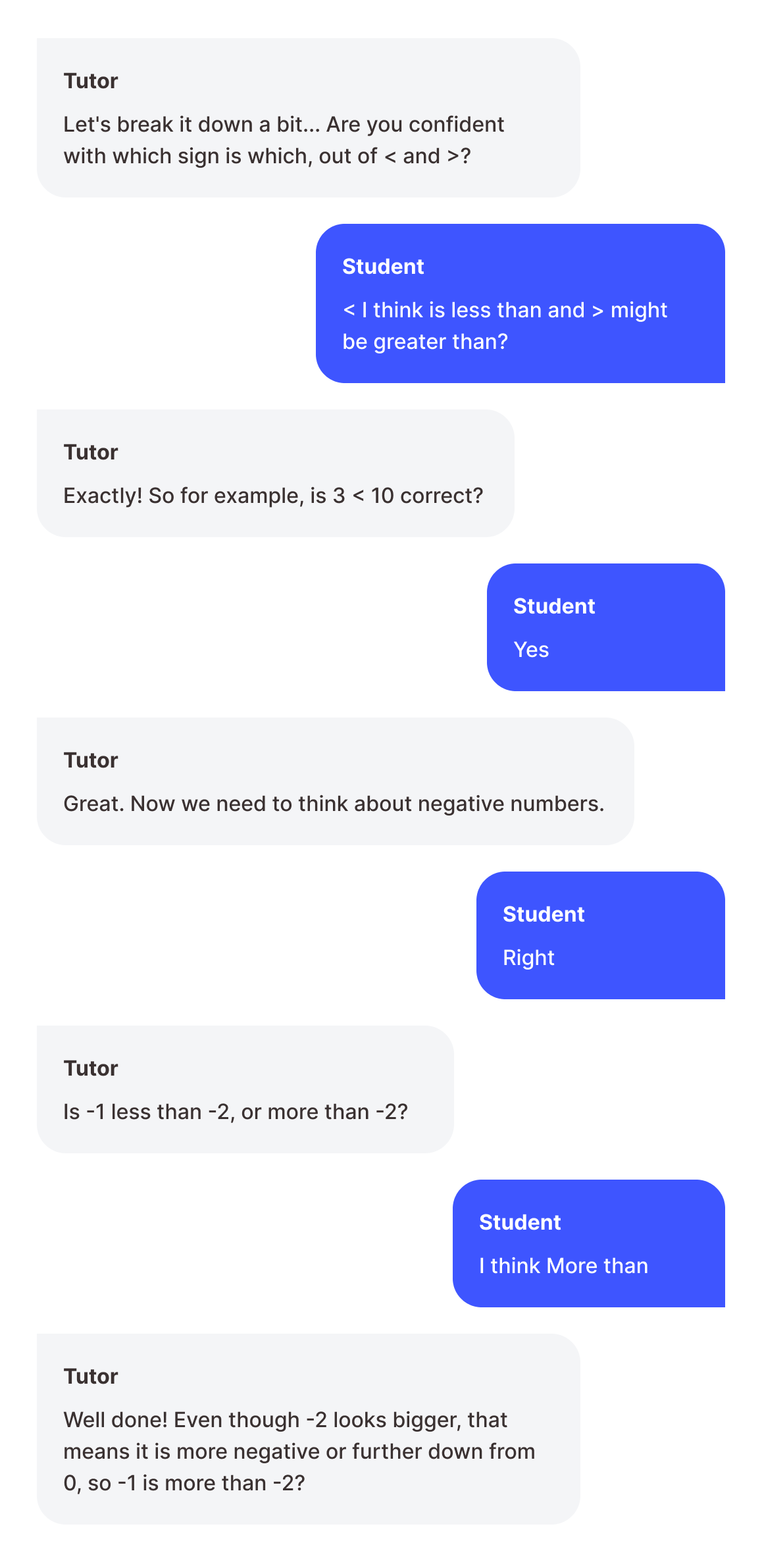
At Eedi, we like to share student data with complete strangers. Here’s a real tutoring conversation for you now:
…
You are probably wondering why we would be so irresponsible, and why we would then have the audacity to write a blog post about it. Well, we do this because Eedi’s mission is to improve the education of 1 billion students by 2030. We’re realistic, we know we cannot do this alone, we are a modest startup based in the UK, but we believe our global ambition can be achieved through collaboration.
So what do we mean by education research? Lots of fields are interested in student data, from learning science to machine learning to psychometrics. Even though each brings a different set of skills, these researchers often want to understand and improve how students learn. Eedi empowers the brightest minds in education research with realistic learning data to train their models and test their hypotheses. And we’ve seen real impact on the scientific community. As of September 2026, 168 papers have been written on the dataset we shared for our first data science competition. And in return, Eedi and other innovators pick up this work and integrate it to make best-in-class edtech solutions.
We’re supportive of a lot of research, provided careful attention is paid to the safety and privacy of everyone represented in our data. Before sharing data with others, privately or publicly, we take multiple steps to steward the trust of our users.
Let’s start with the easy case, identifiers.
We hosted our first data science competition at NeurIPS 2020 with Microsoft Research. We shared students’ answers to multiple choice questions (A, B, C or D), and student and question metadata. A unique UserId identifies the student but here is the crucial bit, that identifier is not the same as the value which appears in our database. We transform the identifier through a process called pseudonymization so different datasets cannot be combined to build a fuller picture of any single student.
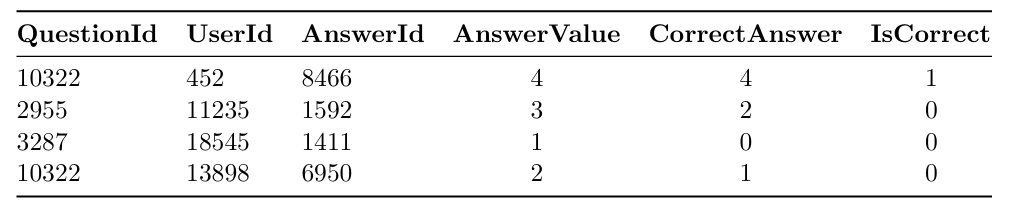
Figure 2. A sample of the pseudonymized NeurIPS 2020 dataset.
Although this dataset looks quite simple and innocuous, it enabled researchers to build models which would predict students’ responses to unseen questions, to assess question quality and to select better questions for students to answer. In fact, it has become a standard benchmark for Knowledge Tracing research. This is great news for us because we are really interested in Knowledge Tracing so we get regular updates on the state of the art!
Free-text student data is a bit more challenging.
We open-sourced our first tutoring dataset at EMNLP 2025 to support the National Tutoring Observatory. Figure 1 is an example from this dataset! At the time, it was the largest open-source real-world tutoring dataset of its kind. The problem is when you give a student a free text field, they can and will type anything. They might mention their name, their phone number, their school, the list goes on…
To address this concern, we developed a framework called PIIvot. The approach uses two steps. First, we developed a machine learning model to over-cautiously find words that might identify a person. This means we detect truly insensitive words like the names in Eedi’s word problems.
Question: [Tom] shares some money with his brother in the ratio 5:4 …
Second, we obfuscate these potential identifiers by replacing them with fake ones using a large language model. This differs from the standard approach that would redact this text.
Hello 👋👋 I'm [NAME] one of the tutors at Eedi!
But redaction has two problems. First, it doesn’t work with our over-cautious identification step because redacting the names from word problems ruins the data for researchers. Second, if you redact text and miss just one identifying word, that word stands out like a sore thumb. Instead, if our model misses a real name, it is buried in a haystack of thousands of fake names.
Public datasets complicate things even further because we don’t always know who will use the data or what they will use it for.
We know that the primary reason students and teachers use Eedi is to learn or teach. They don’t use Eedi to volunteer for research. Therefore, it is extra important that our users are informed about what happens with their data. That’s one of the reasons we’re writing this post! And that’s also why we only support research that supports student learning. But, how do we ensure public datasets are used in ways aligned with our users’ interests?
Our answer takes multiple forms. We use non-commercial licenses and appropriate use statements to define the legal and ethical terms of users’ data. We also intentionally minimize the amount and kind of data we share to reduce inappropriate use. For example, we filter out sensitive topics from student data.
So why go through all this trouble?
Because the alternative is arguably worse. If we keep real learning data locked away, we create a disconnect between the rigor of academia and the scale of edtech solutions. Consequently, academics will be testing amazing solutions with tens to hundreds of students, whilst edtech providers will be scaling suboptimal solutions. Eedi's mission is to improve the education of 1 billion students by 2030. We know we can't do it alone. And, we refuse to sacrifice the trust of our students and educators along the way.