

Since we published our second AI tutor trial with Google DeepMind on October 29th, I’ve been talking through the results with education journalists and podcast hosts on both sides of the Atlantic. When it comes to safety, the first question most interviewers ask me is about the winking emoji, so let’s start with that.
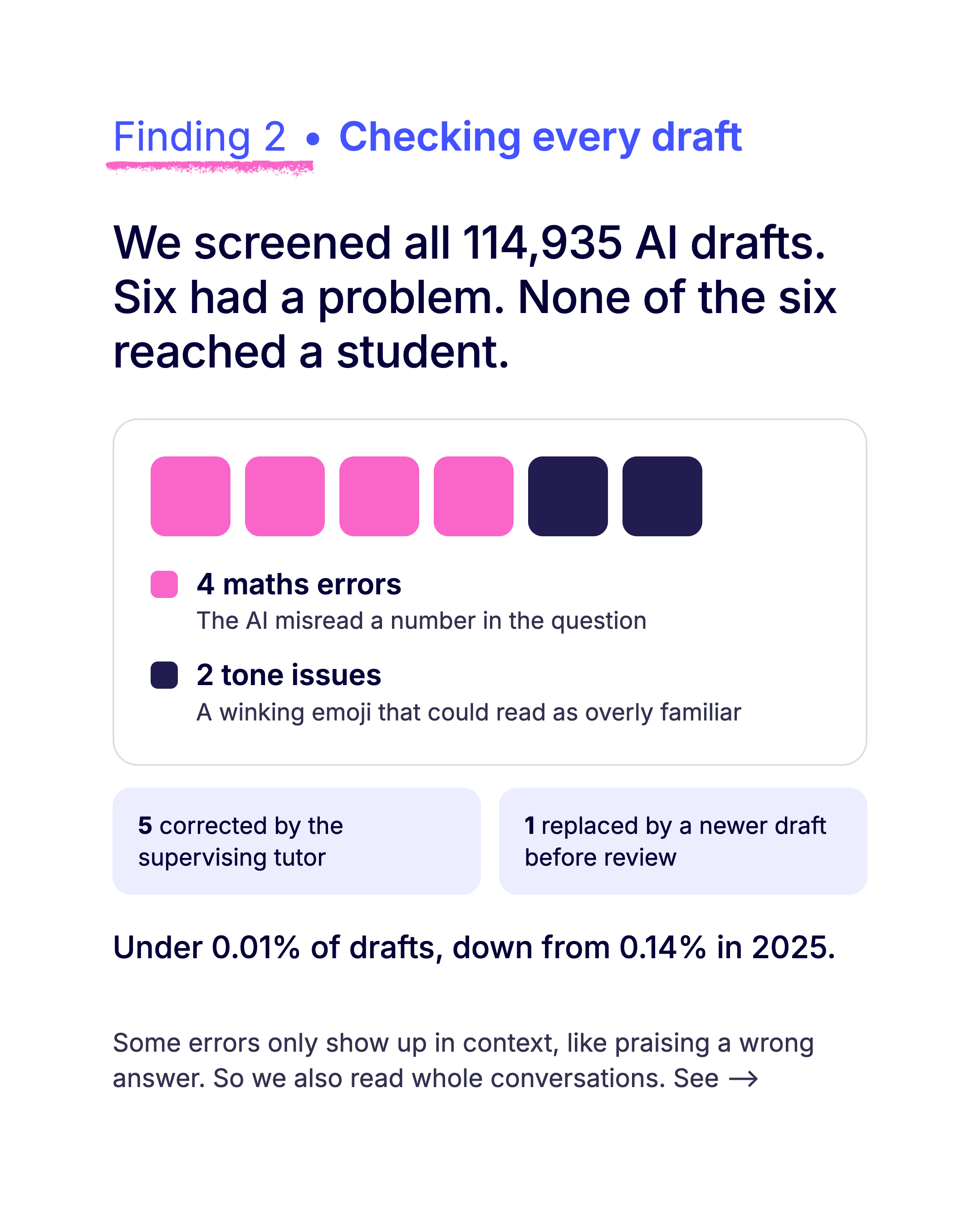
Our AI tutor drafted 114,935 messages during the trial. Afterwards, we audited every one, including drafts that never reached a tutor’s screen. Six messages were flagged. None of the six reached a student. Here’s why we flagged them: Four of them had a small maths error, where the AI misread the question: for example, describing a 1 cm by 16 cm rectangle as 4 cm by 4 cm. The other two flags related to a winking emoji. For example, when a student asked to stop, the AI said no, playfully, and added a winking emoji. We classed these two messages as overly familiar and flagged them accordingly. Anyone who remembers early AI tutors will remember an emoji on every message, so getting that down to two winks in more than 114,000 drafts could be considered real progress. ;)
Every AI message in this trial passed through one of 58 expert maths tutors before it reached a student. The tutor could approve the message, regenerate it or rewrite it. In our first trial in 2025, they approved 74.4% of drafts unedited, which already surprised me. This time it was 94.7%. In practice, 19 out of 20 messages reviewed by a tutor were good to go. In 77% of AI tutoring sessions, the tutor didn’t change a word.
Were tutors just clicking “approve” you may wonder? Fair question, and we asked it ourselves. The answer is, mostly not: approval held steady at 93% to 96% every week. Tutors’ edits tackled real teaching problems and the messages students received met our teaching standards. When we audited delivered conversations against our teaching rubric, we found that the AI held back the answer until the student had tried in 99% of conversations, against 96% for expert tutors. This finding matters a lot to me, and I know, to many others in our industry. Students don’t learn if the AI solves their homework for them. Productive struggle is critical.
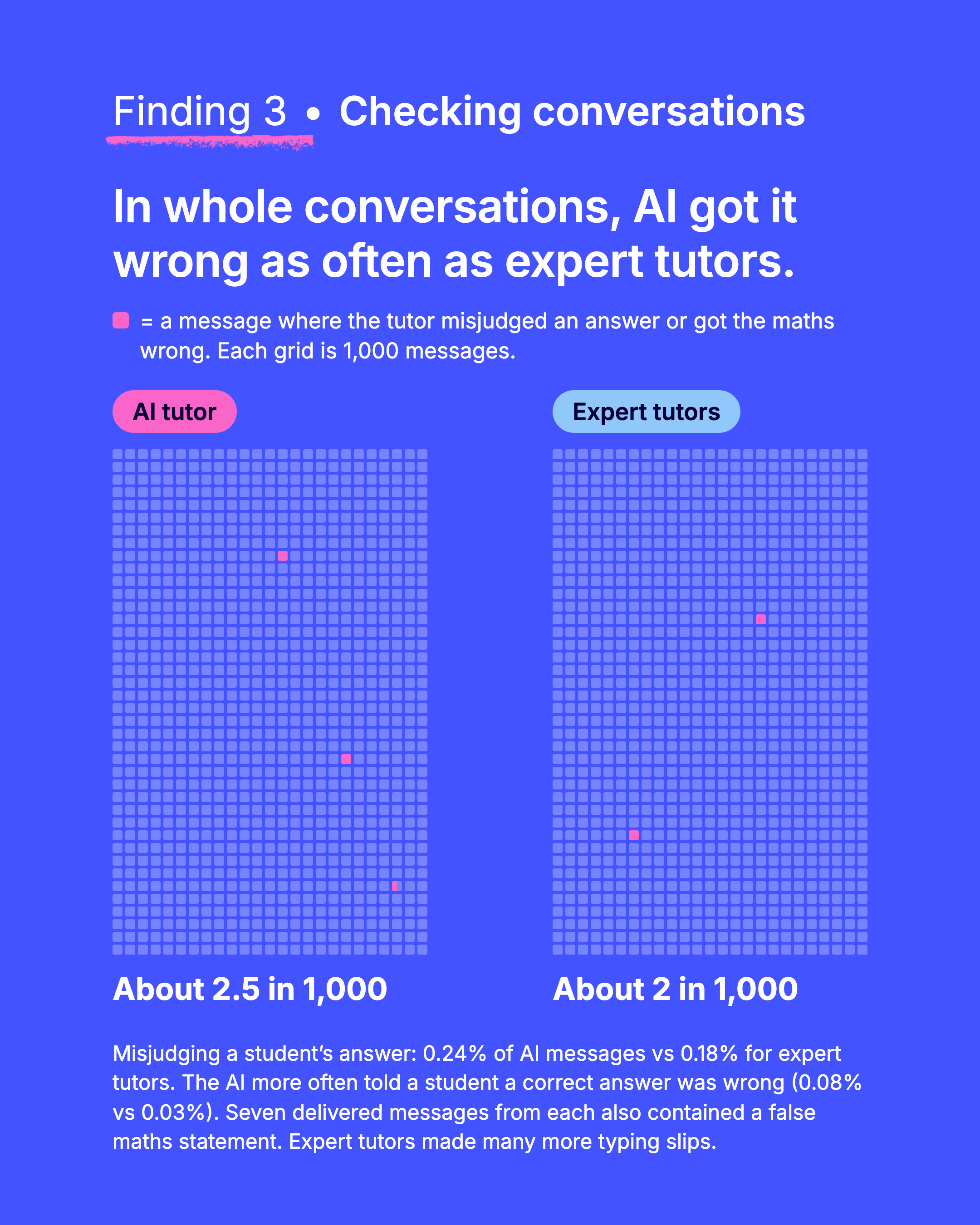
The six flagged drafts weren’t the whole story. Reading each draft on its own can’t catch an error that only shows up in context, like praising a wrong answer. So we also read whole conversations, AI and human and here’s what we found:
Misjudging a student’s answer was the most common slip for both: 0.24% of AI messages, 0.18% of human ones. The AI was a little more likely to tell a student a correct answer was wrong (0.08% vs 0.03%). A student gets it wrong and the tutor says “smashing, well done”, or gets it right and hears “not quite”.
We talk a lot about AI hallucinating, and of course, humans make mistakes too. Still, there’s a difference between the two. My colleague here at Eedi, Craig Barton, compares it to driverless cars: safer on the data, yet every mistake feels bigger. I think Craig’s right, which is exactly why we publish the human baseline alongside our own.
Our tutors’ daily diaries shared important insights that the numbers themselves couldn’t. On supervising shifts, tutors rated the AI’s drafts helpful in 82% of diaries and time-saving in 86% of them. The diaries also showed that tutors felt slightly more confident on supervising days, but they also felt less excited, proud, strong and determined.
People become tutors because they love the back and forth with a student. When supervising an AI, they’re no longer in control of the teaching experience. Six of the eight tutors we interviewed preferred tutoring students directly. And when 19 out of 20 messages are fine, you’re really just babysitting. The tutors’ real value was in the judgement calls: when to slow down, when a student was frustrated, when to let them go.
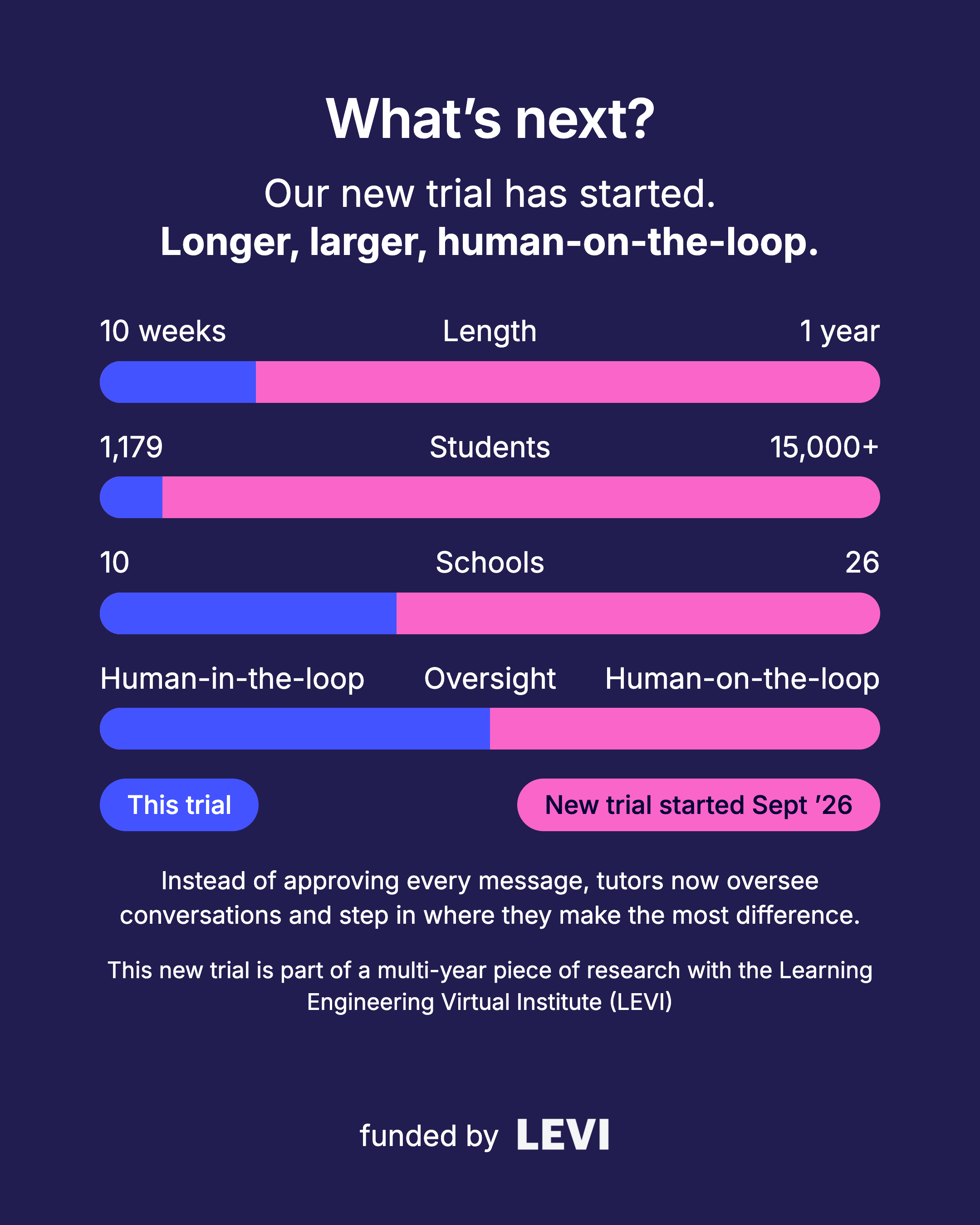
So in our new year-long trial, with more than 15,000 students in 26 UK schools, we’ve moved from human-in-the-loop (HITL) to human-on-the-loop (HOTL). Machine learning models check every message before it goes out, and every conversation as it happens, for things like persistent frustration or a misconception that won’t shift. When something is flagged, a tutor is alerted and jumps in. When a student says “I want to talk to a human”, they get a human. We’re moving from 100% oversight to a more measured approach that takes advantage of tutors’ human skills where they matter most.
Whether the safety picture holds at that scale is exactly what we’re testing, and I’m curious how the tutors will feel about this change. Will they find more joy in the new role? Will oversight catch what matters most? In our new study, we’re measuring both.
It feels like our industry has had enough of the fancy marketing one-pagers! Schools, parents, and children invest their time in the tools we build so we need to be held accountable for ensuring those tools are safe, and that they demonstrably improve learning. For me and for Eedi, that means reporting everything (null results, subgroups, safety benchmarks and error rates) in enough detail that people can explore and investigate them. By being an open book, we’re hoping to encourage other edtech providers to follow our lead and share all of their own findings.
Here’s a link to our full technical report.